

Shockwave Therapy – Information For GPs
Evidence-Based Treatment for Chronic Pain & Musculoskeletal Injuries – Melbourne & Caroline Springs
Live Well Health Centre provides radial and focused shockwave therapy to help reduce pain, stimulate tissue healing, and accelerate recovery in persistent musculoskeletal conditions.
Shockwave therapy is a non-invasive, research-supported treatment commonly used when symptoms have not improved with rest, exercise, or standard conservative care.
Referral Information for GPs
Shockwave Therapy at Live Well Health Centre
Live Well Health Centre provides evidence-based radial and focused extracorporeal shockwave therapy (ESWT) for persistent musculoskeletal conditions, particularly when standard conservative management has not produced sufficient improvement.
Our service is designed to support coordinated care between GP, patient, and treating practitioner.
When to consider referral for shockwave therapy
Shockwave therapy may be appropriate for patients with:
- Chronic plantar heel pain (plantar fasciitis / fasciopathy)
- Achilles or patellar tendinopathy
- Lateral epicondylalgia (tennis elbow)
- Calcific rotator cuff tendinopathy
- Chronic soft-tissue pain or trigger points
- Persistent tendon pathology not responding to loading programs
- Symptoms lasting >3–6 months despite conservative management
Shockwave may also be considered where patients wish to avoid or delay injection therapy or surgical intervention.
Treatment approach
Patients undergo:
- Clinical assessment and diagnosis confirmation
- Evidence-informed shockwave protocol
- Integration with loading and rehabilitation programs where indicated
- Progress monitoring and outcome review
Typical course: 3-5 sessions spaced weekly, adjusted based on response.
Equipment
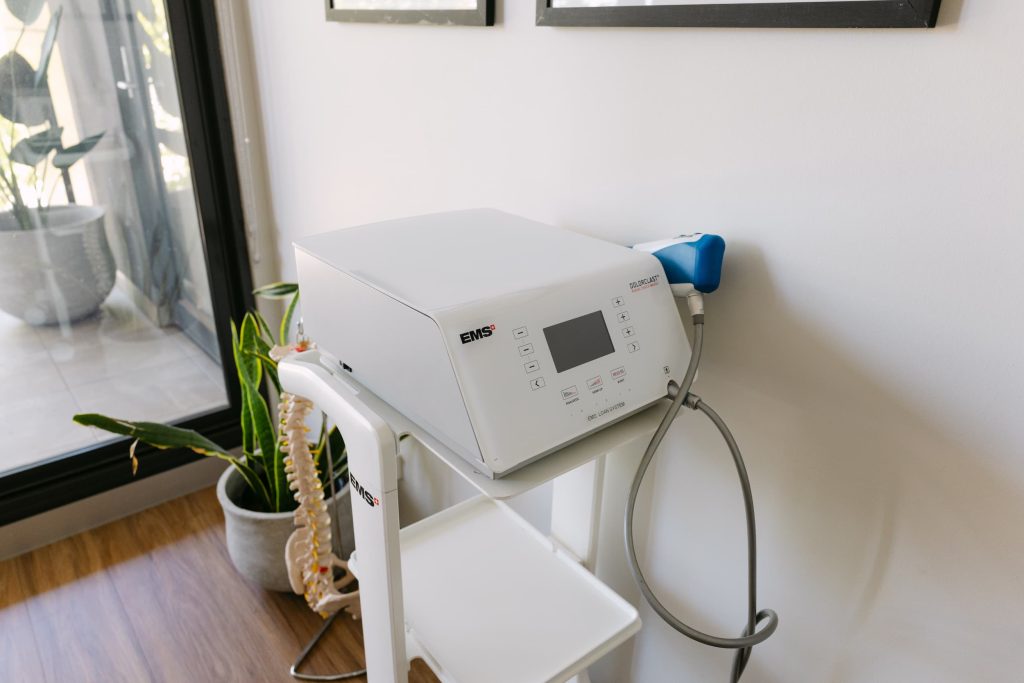
Treatment is delivered using the EMS DolorClast® radial and focused shockwave system, a clinically validated device widely used in research and specialist practice internationally.
Communication with referring GP
Where appropriate, we provide:
- Initial assessment summary (if requested)
- Progress updates if clinically indicated
- Outcome report following treatment completion
Our goal is collaborative, patient-centred care.
How to refer
Referrals can be sent via:
Email: [email protected]
Phone: 03 9363 2961
Please include:
- Diagnosis or working diagnosis
- Relevant imaging (if available)
- Previous treatments trialled
- Medical considerations or contraindications
Formal referral is not required for treatment but is welcomed for coordinated care.
Clinical governance
Treatment protocols are based on current research and clinical guidelines for extracorporeal shockwave therapy in musculoskeletal medicine.
Patients are screened for contraindications prior to treatment.
Research Evidence Supporting Shockwave Therapy
Extracorporeal shockwave therapy (ESWT) has a substantial and growing evidence base for the treatment of chronic musculoskeletal conditions, particularly tendinopathies and plantar heel pain.
Below are key systematic reviews, clinical guidelines, and research summaries.
Systematic Reviews and Meta-Analyses
Lou et al., 2022 — Systematic review of ESWT for tendinopathies
Demonstrated significant improvements in pain and functional outcomes across multiple chronic tendon conditions.
PMCID: PMC9382436
Gerdesmeyer et al., 2008 — Randomised controlled trial, plantar fasciitis
Showed significant clinical improvement following radial shockwave therapy compared with placebo.
Journal of Rheumatology, 33(7):1351–1357
Cochrane Review — ESWT for plantar heel pain
Concluded shockwave therapy provides pain reduction and functional improvement in chronic plantar heel pain.
DOI: 10.1002/14651858.CD013490
Clinical Guidelines
Journal of Orthopaedic & Sports Physical Therapy (JOSPT), 2023 — Heel Pain Clinical Practice Guideline
Recommends extracorporeal shockwave therapy as an evidence-based intervention for plantar fasciitis not responding to conservative care.
Sports Medicine and Rehabilitation Reviews
Mani-Babu et al., 2015 — Comprehensive review of ESWT in musculoskeletal disorders
Concluded ESWT is an effective and safe non-invasive treatment across a range of tendon and soft-tissue conditions.
British Journal of Sports Medicine.
Shoulder / Calcific Tendinopathy Evidence
Clinical treatment algorithms support shockwave therapy for calcific rotator cuff tendinopathy, demonstrating:
- Pain reduction
- Functional improvement
- Calcific deposit resorption
Referenced in contemporary shoulder management literature.
Evidence summary for clinicians
Across high-quality studies, ESWT demonstrates:
- Clinically meaningful pain reduction
- Functional improvement
- Good safety profile
- Strongest evidence in chronic tendon pathology
- Best outcomes when combined with structured rehabilitation
Device-specific clinical information
Additional technical and clinical resources for the EMS DolorClast system are available via: