Kinesiology Taping (RockTape) in Osteopathy
Movement Support & Pain Relief Without Restricting Motion — Melbourne & Caroline Springs
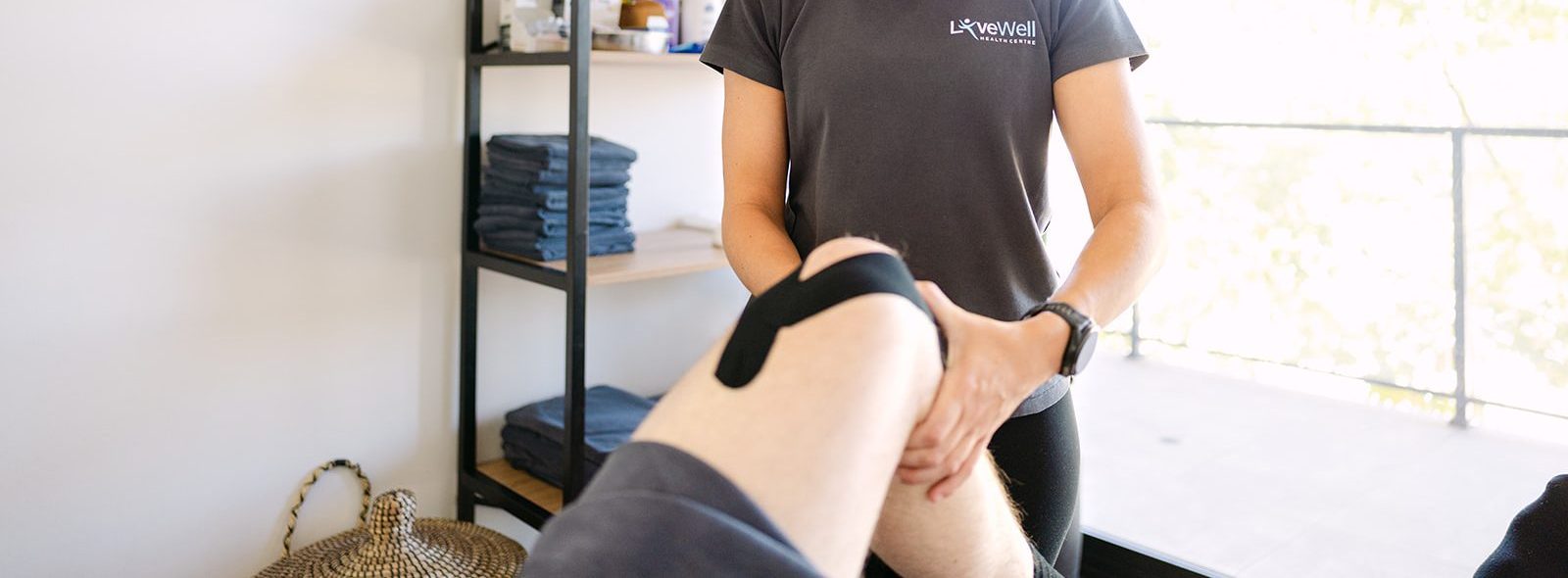
Kinesiology taping is a supportive treatment technique osteopaths may use to help reduce pain, improve movement, and support recovery.
At Live Well Health Centre, we use RockTape®, a premium kinesiology tape known for its durability, skin comfort, and clinical performance.
Taping is used as part of a broader osteopathic treatment plan — not as a stand-alone solution.
What is it? (plain English)
Kinesiology tape is a specialised elastic therapeutic tape applied to the skin to support muscles and joints while still allowing full movement.
Unlike rigid sports tape, kinesiology tape stretches and moves with your body.
This allows it to:
- Support injured or irritated tissue
- Reduce strain on muscles and joints
- Provide sensory feedback for movement
- Assist recovery during activity
At Live Well, we exclusively use RockTape® because of its superior stretch, adhesive quality, and clinical reliability.
Learn more about RockTape® here: https://www.rocktape.com
How it works (simple physiology)
Kinesiology tape works through mechanical support and nervous system effects.
When applied correctly, it may:
- Gently lift the skin
- Improve local circulation
- Reduce pressure on sensitive tissue
- Provide sensory feedback to the nervous system
- Influence muscle activation and movement patterns
This sensory input can help the body move more efficiently and with less discomfort.
Taping does not “hold structures in place” — it helps guide movement and reduce strain.
Who it helps / conditions treated
Kinesiology taping may assist people with:
- Muscle strain or overload
- Joint irritation
- Sports injuries
- Tendon pain
- Postural strain
- Swelling or fluid accumulation
- Movement control issues
- Rehabilitation support during activity
It is particularly useful when movement is needed but tissue support is helpful.
Common uses include:
- Shoulder support
- Knee tracking support
- Back muscle strain
- Tendon irritation
- Sports performance support
What to expect in treatment
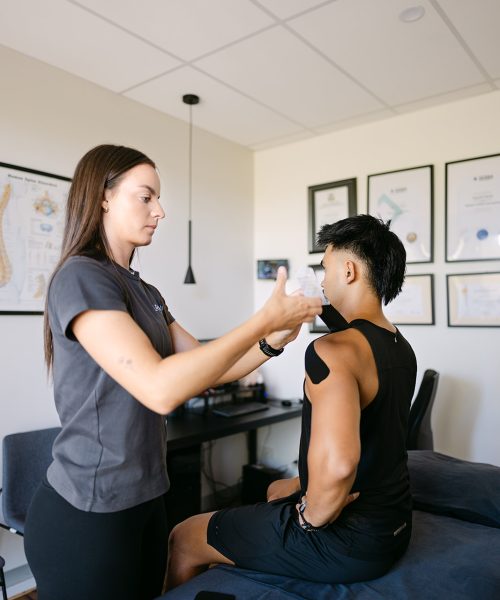
Your osteopath will:
- Assess your condition and movement patterns
- Apply tape in a specific direction and tension
- Provide care instructions
The tape:
- Can stay on for several days
- Is water resistant
- Moves with your body
You can usually continue normal activity while wearing it.
Evidence & research
Research into kinesiology taping shows mixed but promising results depending on the condition and application.
Some studies suggest taping may:
- Reduce short-term pain
- Improve proprioception (body awareness)
- Support movement control
- Improve function during rehabilitation
Effects are often modest and vary between individuals.
Taping is most effective when used alongside rehabilitation and manual therapy — not alone.
Key research examples
Williams et al., 2012 — Systematic Review
Found limited to moderate evidence for pain reduction and improved range of motion in some musculoskeletal conditions.
Sports Medicine.
Parreira et al., 2014 — Systematic Review
Reported small short-term benefits for pain and disability in musculoskeletal conditions.
Journal of Physiotherapy.
Lim & Tay, 2015 — Meta-analysis
Found kinesiology taping may improve pain and function in some clinical populations, but effects vary by condition.
Clinical interpretation
Kinesiology taping is best used as:
- Supportive therapy
- Movement assistance
- Rehabilitation adjunct
It complements treatment — it does not replace it.
Safety and suitability
Kinesiology taping is generally very safe.
Possible minor effects:
- Skin irritation (rare)
- Mild itching
- Sensitivity to adhesive
Tape should not be applied over:
- open wounds
- fragile skin
- certain skin conditions
Your osteopath will assess suitability before applying tape.
Frequently asked questions
How long does the tape stay on?
Usually 3–5 days depending on skin type and activity level.
Can I shower with it?
Yes. RockTape is water resistant. Pat dry after showering.
Does taping fix the injury?
No. It supports recovery but does not replace rehabilitation.
Will I become dependent on tape?
No. It is used temporarily to support movement while healing improves.
Why do you use RockTape specifically?
RockTape has higher elasticity, stronger adhesive, and better durability than many standard kinesiology tapes. This improves treatment effectiveness and comfort.
Why we use RockTape at Live Well
We use RockTape because it:
- Supports movement without restriction
- Reduces strain during recovery
- Improves body awarenes
- Helps patients stay active safely
- Integrates well with rehabilitation programs
We choose premium clinical materials to maintain high treatment standards.
Integration with rehabilitation (our point of difference)
At Live Well, taping is used alongside:
- Exercise rehabilitation
- Clinical Pilates
- Manual therapy
- Movement retraining
This ensures taping supports long-term recovery — not just short-term relief.
Related treatments
- Exercise Rehabilitation
- Soft Tissue Therapy
- Shockwave Therapy
- Dry Needling
- Joint Mobilisation