
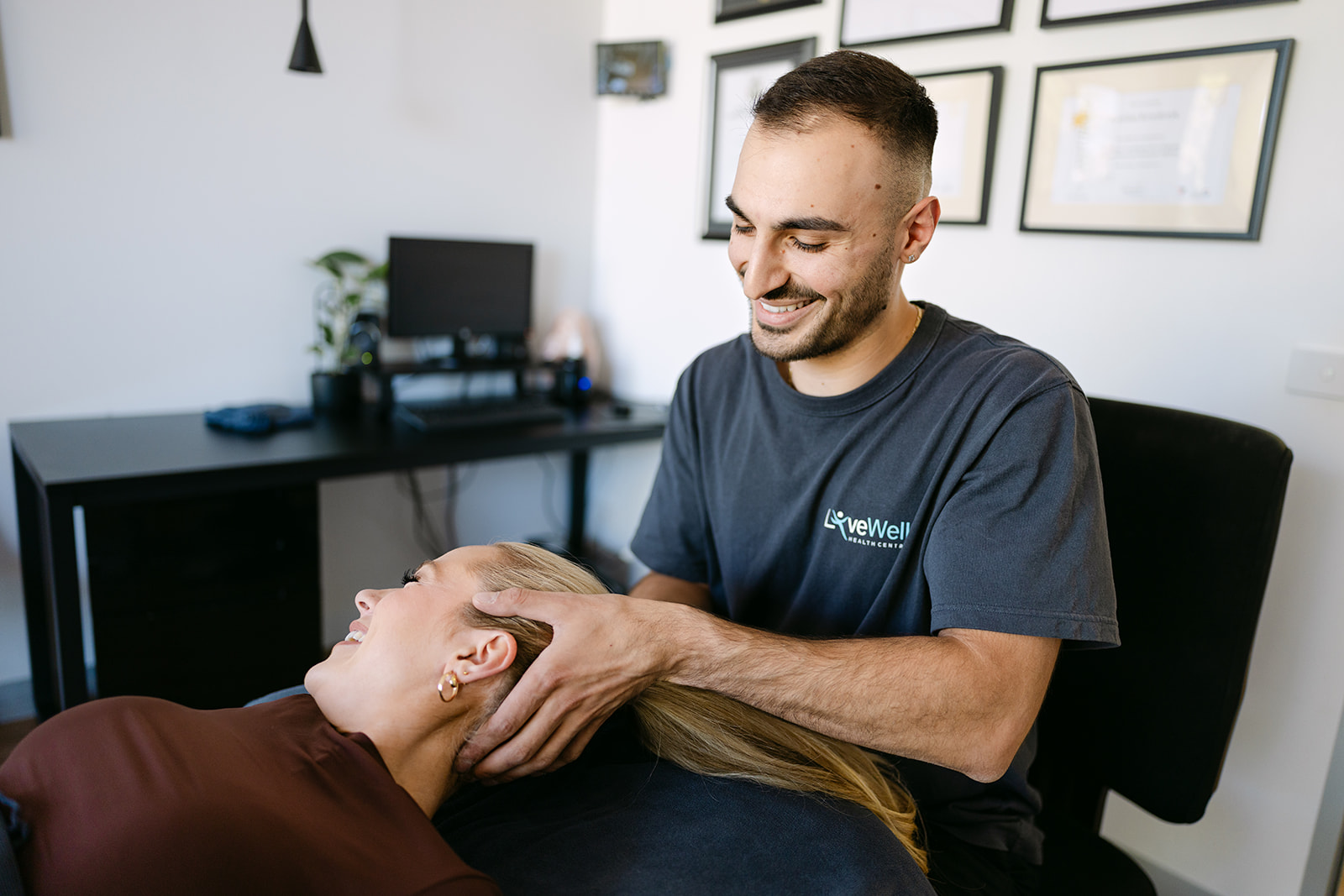
HVLA Manipulation (High-Velocity, Low-Amplitude)
Precise Joint Treatment to Improve Movement & Reduce Stiffness — Melbourne & Caroline Springs
HVLA manipulation is one of the manual therapy techniques osteopaths may use to help restore joint movement and reduce stiffness.
At Live Well Health Centre, HVLA is used selectively — only when clinically appropriate and after full assessment.
Not sure what’s causing your pain?
HVLA stands for High-Velocity, Low-Amplitude.
It is a precise manual technique where a trained osteopath applies a quick, controlled movement to a specific joint that is not moving as freely as it should.
The aim is to:
- Restore joint mobility
- Reduce stiffness and discomfort
- Improve surrounding muscle function
- Improve nervous system signalling around the joint
You may hear a clicking or popping sound during treatment. This is a normal release of gas within the joint — not bones cracking or damage occurring.
HVLA is always used following a full clinical assessment and only when appropriate.
How it works (simple physiology)
Restricted joints can affect how surrounding muscles and nerves function.
HVLA may help by:
- Improving joint range of motion
- Reducing mechanical stiffness
- Influencing muscle reflex activity
- Reducing protective muscle guarding
- Changing how the nervous system processes movement
The audible “pop” is known as joint cavitation, caused by pressure changes in joint fluid — similar to opening a carbonated drink.
This sound is not required for the technique to be effective.
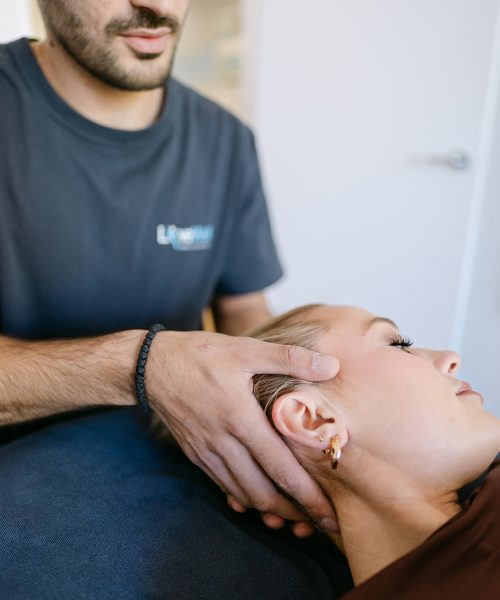
Who it helps / conditions treated
HVLA may be suitable for people with mechanical joint restriction, including:
- Neck stiffness
- Mid-back or rib restriction
- Lower back stiffness
- Reduced spinal mobility
- Some headaches related to neck movement restriction
- Mechanical joint pain (e.g. ribs, pelvis)
It is often used when joint stiffness contributes to pain or reduced movement.
HVLA is usually combined with other treatments as part of a personalised care plan.
What to expect in treatment
Your osteopath will:
- Take a detailed history and perform assessment
- Explain the technique and obtain consent
- Position the joint carefully
- Apply a quick, precise movement
The movement is brief and controlled. Many people feel immediate improvement in mobility.
Some mild soreness can occur afterwards, usually settling within 24–48 hours.
Evidence & research
HVLA is a form of spinal or joint manipulation — one of the most studied manual therapy approaches for musculoskeletal conditions.
Research suggests spinal manipulation may:
- Reduce pain in some back and neck conditions
- Improve mobility
- Improve short-term function
- Support recovery when combined with exercise
Results vary depending on condition and individual response.
Key research and guideline references
Rubinstein et al., Cochrane Review — Spinal manipulative therapy for chronic low back pain
Found manipulation provides similar or modestly improved outcomes compared with other recommended treatments.
American College of Physicians Clinical Practice Guideline (2017)
Recommends spinal manipulation as a non-pharmacological treatment option for acute and chronic low back pain.
National Institute for Health and Care Excellence (NICE) Guideline — Low Back Pain
Recommends manual therapy including manipulation as part of a treatment package with exercise.
Clinical interpretation
HVLA is best viewed as:
- A mobility restoration technique
- Most effective when combined with rehabilitation
- One option within a broader treatment plan
Safety and suitability
HVLA is considered safe when performed by appropriately trained healthcare professionals following proper screening.
Like all medical interventions, suitability must be assessed individually.
Safety and regulation in Australia
In Australia, osteopaths are regulated health professionals.
To perform HVLA safely, osteopaths must:
- Be registered with AHPRA
- Complete accredited university training (4.5–5 years)
- Meet national practice standards
- Maintain ongoing continuing professional development
This ensures clinical competence and patient safety.
Regulation source:
Australian Health Practitioner Regulation Agency (AHPRA)
Osteopathy Board of Australia
Who performs HVLA?
At Live Well, HVLA is performed only by qualified registered osteopaths trained in manual therapy and clinical risk assessment.
A full clinical examination is always completed before treatment.
Your consent is required.
When HVLA may not be appropriate
HVLA is not suitable for everyone.
It may be avoided or modified in people with:
- Osteoporosis or reduced bone density
- Recent fracture or trauma
- Active inflammatory joint disease
- Certain neurological or vascular conditions
- Joint instability
- Severe unexplained pain
- Medical conditions affecting connective tissue
It is also not used if a patient prefers gentler techniques.
Your safety and comfort always come first.
Integration with rehabilitation (our point of difference)
At Live Well, HVLA is not used in isolation.
It is integrated with:
- Soft tissue therapy
- Exercise rehabilitation
- Movement retraining
- Clinical Pilates where appropriate
This combination helps ensure improved mobility translates into lasting function.
Frequently asked questions
Is the “crack” necessary?
No. The sound is not required for benefit.
Is HVLA safe?
Yes — when performed by a trained registered practitioner following proper screening.
Will it hurt?
Most people feel pressure or brief discomfort, not pain.
Do I have to have manipulation?
No. It is always optional. Alternative techniques are available.
How long do effects last?
This depends on underlying movement patterns and rehabilitation.
Why we use HVLA at Live Well
We use HVLA when clinically appropriate because it can:
- Quickly restore joint mobility
- Reduce stiffness
- Improve movement comfort
- Support rehabilitation progress
It is one of many tools used to help the body move normally again.
Related treatments
- Joint Articulation
- Soft Tissue Therapy
- Muscle Energy Technique
- Exercise Rehabilitation
- Myofascial Release
Clinical disclaimer
High-Velocity, Low-Amplitude (HVLA) techniques are not appropriate for all patients or conditions. Use is determined only after comprehensive clinical assessment and consideration of individual risk factors. Treatment decisions are based on clinical judgement, current best practice, and patient-specific findings. HVLA is performed only when clinically appropriate and with informed consent. Alternative techniques are available where HVLA is not indicated.